The Climate Action Teacher Champion programme is now recruiting for round three, starting in January 2024. If you are a teacher, consider yourself invited – or nominate a colleague! If you’re a parent or a student, tell your school about it and get them involved. Send them a link, or download and send the flyer below.
The scheme has already worked with a dozen schools in Luton to train teachers and develop climate action plans. Participating schools have gone on to found eco-teams, draw up plans for new gardening areas, and introduce new ideas to reduce food waste and boost recycling. There are two roof-gardens in the works, as well as new and renovated ponds, wildflower meadow and tree-planting plans. At least one school is investigating solar panels to reduce costs and carbon emissions.
“Most of what we’ve focused on is improving our school environment,” says Sam Clarke from Wigmore school, who took part in round one of the CATCh programme. “Our whole outdoor area needed a refurb, to cut pathways through, to do some wildflowers, to increase biodiversity. We have a pond but it’s dried up and it’s just a concrete shell, so that’s getting fixed and lined. We’ve got a lot of ideas, and it will take a year to work through them, but in the end it will be such a nice place for the children, for them to come outside and learn about their environment, about biodiversity, and to really care and make a difference.”
The CATCh programme consists of six weeks training, in both online and in-person sessions. This happens with teachers from other schools, as part of a learning community of like-minded educators. Teachers then work on a one-to-one basis with an experienced facilitator from one of the partner organisations, and develop a climate action plan for their specific context. It brings all the many options around sustainability into a practical and manageable plan. Participating schools also receive a £1,000 grant to get them started on their eco actions.
Teachers from round two are finished the programme and completing their plans by Christmas, with round three now recruiting. To join the scheme, please email myclimate@luton.gov.uk
The council has launched a retrofit open home for the Autumn, and is inviting visitors to tour the property and see some low carbon technologies for themselves.
The house is a three bedroom family home on Abbotswood Road, Round Green. Over the summer it was retrofitted to low carbon standard, in partnership with Luton Rising. It features a number of points of interest for those looking to reduce both their carbon emissions and their bills:
Solar panels and storage battery
Heat pump
Heating controls
Insulation and triple glazed windows
Compost demonstration
Open the cupboard under the stairs, and you will find the building’s gas pipe, now closed off and capped. This is an all-electric home, powered by the solar panels on the roof. The batteries, also under the stairs, capture solar power to use at night, and the system can provide around three quarters of the home’s electricity needs.
Step into the garden and visitors can see compost and leaf mould demonstrations, courtesy of Edible High Town. They have also added a little sign drawing attention to the ‘energy-saving solar and wind powered clothes dryer’, known to you and I as a washing line and proving that not all green tech is high tech.
Against the back wall visitors can see the heat pump, gently whirring. (You may have read the recurring complaints online that heat pumps are noisy – come and listen for yourself!) The heat pump captures warmth from the outside air, even in low temperatures, and pipes it into the boiler. That then supplies the radiators.
Because it uses heat from the environment rather than burning fuel to create warmth, heat pumps are very efficient. In this house, it’s also being powered by the solar panels and this will mean very low bills for future residents.
Those future residents are expected in mid-January, so there is a limited time to visit the show-home. With a housing shortage in Luton, a council house can’t be kept empty for long, so visit it while you can.
As well as demonstrating the technologies to interested people, the home is also a way of testing those technologies in a council home. Luton has just under 8,000 council homes of one kind or another. Moving them towards low carbon will help to meet our climate targets, but it will have lots of other benefits as well.
“We’re taking a start to finish approach to sustainable housing,” said Dylan Katuwawala, Principle Climate Change Office at the council, as he showed me around the house. “That begins with upskilling and green jobs to deliver retrofits, and results in warmer homes and lower bills for residents. It will reduce our carbon emissions with all sorts of co-benefits along the way, from improved health and wellbeing to addressing fuel poverty.”
Community gardener Konni Deppe tells the story of Luton’s fruit trees and orchards, and an inspired idea to use up surplus apples.
The problem
Do you know of an apple tree near you where the fruit doesn’t get picked? You’re not alone.
Surprisingly, many fruit trees in Luton’s back gardens and public places go unharvested. Fruit will still provide food for birds and insects, but some of it ends up in people’s brown or even black bins, and make its way into landfill or incineration, adding to our CO2 emissions.
At the same time, many people have lost a connection to our rich orchard heritage. Over centuries, more than 2,000 varieties of apples have been bred in England alone. However, modern varieties are grown for appearance, and ease of picking, storing and shipping, rather than flavour. Today’s supermarkets only offer a tiny selection of apples, often imported. The last greengrocer in Luton who sold local varieties, Round Green Fruiterers, closed more than 6 years ago.
Trees can produce a ‘glut’ of fruit over a few weeks and then nothing for the rest of the year. Today’s households are often not geared up to preserve or store them, nor do people have the time, so it’s easy to see why going to the supermarket can seem like a convenient alternative.
The idea
One of the easiest ways to deal with the excess fruit is to turn it into juice or cider.
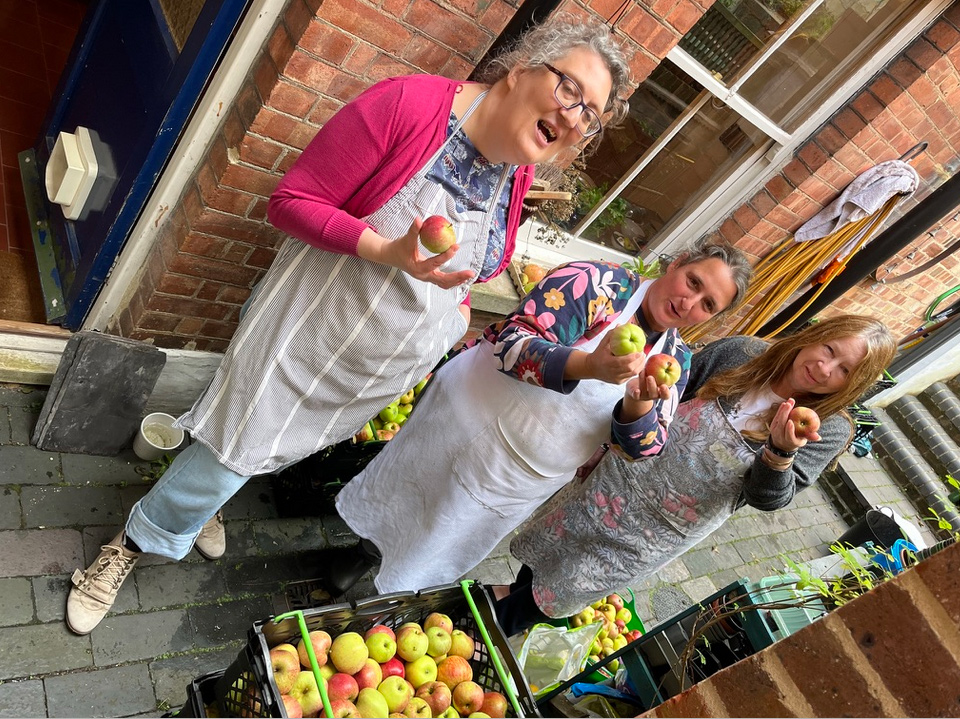
Inspired by a similar project in nearby Hitchin’s Triangle Garden, I wondered whether I could collect this fruit and turn it into apple juice instead. So the Luton Apple Amnesty was born.
Apple amnesties are an idea that’s been around for a while. Many towns and villages across the UK and Europe are making their own apple juice from local crops.
Apple Amnesty – how it worked
To test the process from tree to bottle, the Edible High Town team and I produced a very small batch of juice last year. We offered a tasting event at St Matthew’s Primary School. People absolutely loved the juice, and it was sold out by Christmas.
This year, to be able to scale up, we joined forces with the social gardening project Penrose Roots and applied for a grant from Love Luton to help us pre-finance the juice.
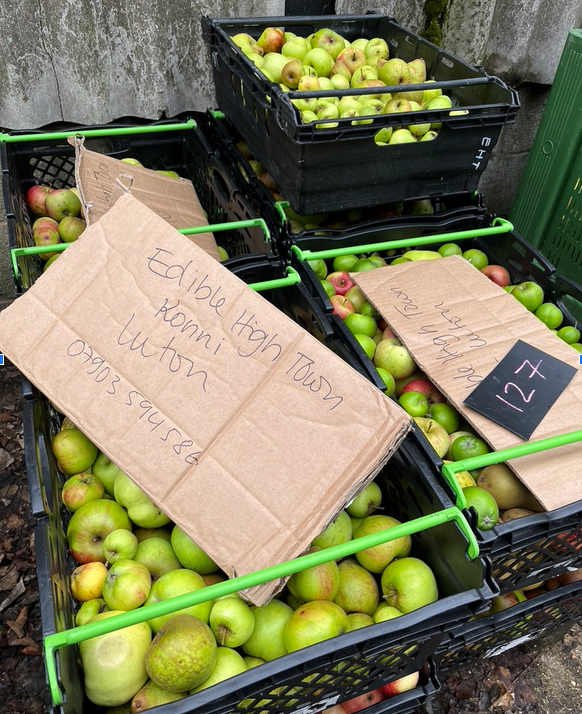
We had two drop-off locations where people could leave their harvest on specific days in October. For people who had a lot of fruit but couldn’t harvest or drop it off themselves, we did ‘home visits’ and picked them straight from their trees.
We found that some fruit trees were surprisingly bare this year, which may have been due to the late frosts in spring. This shows that the more varieties of fruit trees we have, with early and late-blossoming types, the more resilient we’ll be, no matter the weather.
We supplemented garden apples with harvests from local community orchards, and fruit from places such as Grasmere Nursery School (yes, this school has its own orchard!), Luton Hoo Walled Garden, and the Stockingstone Road Allotment orchard.
Volunteers checked the donated apples for quality and to ensure a good mix of ‘cookers’ and ‘eaters’. Together with Penrose Roots we organised the transport to Apple Cottage Cider press in Radwell, who professionally pressed, pasteurised and bottled our local crop.
In total we had 18 donations racking up 250 kg of apples, resulting in 227 bottles of delicious juice. The finished drink stores for 18 months, extending the time people can enjoy local produce.
In the process we discovered several heritage varieties growing people’s back gardens from Laxton’s Superb and Worcester Pearmain to more obscure cultivars that we’re still in the process of identifying.
Local designer Jenna created a label which includes the names of the apple varieties in the juice. Look closely at the bottle, and you can even see the Luton skyline in the background!
Each donor who contributed more than 10 kg of fruit will receive a free bottle, and we’ll give some away to our helpers and donate some to good causes.
The remaining bottles will be sold to help fund orchard activities in Luton such as pruning courses this winter. The juice is available at a suggested donation of £4 per bottle, for example at the High Town Christmas Market on 1 December.
More than juice
The Luton Apple Amnesty is one piece of a wider project with the aim of turning Luton’s fruit trees and community orchards into productive, wildlife-friendly places that are loved by the community.
In the long term, a great achievement would be that no fruit goes to waste in Luton, that community orchards and garden trees are well cared-for, and that no fruit tree is felled where it could have been restored with careful pruning.
We share our work with regional and national organisations, to show off the best of Luton and its orchards. We are already connected to the Bedfordshire and Luton Orchards Group (BLOG), the East of England Apples and Orchards Project (EEAOP), and the Orchards East Forum (University of East Anglia).
You can support the work by buying local apple juice, donating fruit from your tree, or volunteering with many fruit-tree activities. For more information and contact, visit: www.lutonorchards.org.
Green Hubs are regular meetings for those interested in environmental action, and there are lots of them around the country. Luton doesn’t have one at the moment, though there have been similar ideas in the past. Shall we put that right?
Luton Friends of the Earth and other groups in the town are hosting an inaugural Green Hub meeting at High Town Methodist Hall on Thursday the 9th of November, 7pm to 9pm.
The meeting will be a place where “local green and community groups can meet and plan joint activities,” says Mike Oliver. “One project will be to have a meeting where we ask general election candidates what they will do to improve things in Luton, for the people and our environment. Come if you can.”
There’s always more going on in the area than most of us know about, so come along and hear what others are up to. Meet like-minded people, and help to plan some actions and events together. Please share and spread the word, and hopefully see you there.
After a life at sea driving cruise ships, Jesse Bryce now works in energy efficiency in the cargo industry. He shares how he made his ex-council Luton home zero carbon for £4,200.
Decarbonising my home started not from what I should do, but from what I could do. By taking one step at a time, the gas supply has now been disconnected and capped off.
When I bought my house I had simple gas hobs. A nightmare to clean, and of course the windows fogged up every time I used them. That moisture on the windows indicated more moisture in the air – making it harder to heat the house too!
With a supply already wired to my kitchen, an electric induction hob was an easy choice, and a Bosch 4 ‘burner’ cost me £400 installed. It heats up faster, the kitchen stays cooler in summer and the only steam is from the food – not all the gas being burned. Better for cooking, easier to clean, and better indoor air quality too!
One of the most talked about aspects of decarbonising homes is our heating. The standard approach in the UK is to plumb an air-to-water heat pump into our radiators, circulating warm water as we’ve done for decades. To work well, it needs a well designed system to ensure the heat pump, the radiators and the pipes that connect them all meet the needs of our homes. Even with all that done right, for a smaller home like mine even a small 5 kW heat pump is still too large!
I was raised in New Zealand, where gas grids aren’t as common as here in the UK. Kiwis moved to adopt air-to-air heat pumps, often known as air con units! These are simple, cheap, quick to install units that are often more efficient at heating than their air-to-water counterparts.
For £2,000 installed, a single 3.5 kW Mitsubishi air con unit in my living room pushes more than enough heat through my home, ticking over low and slow to maintain temperatures. Most of the time I don’t notice it’s on, though when we hit minus seven outside the warm bubble around my couch was nice!
Because it’s pushing warm air into the area, I find it’s better at keeping my living room comfortable than my radiators ever were – all their heat seemed to disappear straight upstairs. And an extra bonus, no more creaking radiator pipes waking me up!
Having sorted my heating, it left my gas combi boiler only producing hot water. The step to take the boiler out was a bigger one – it meant I couldn’t use my radiators even if I wanted to. With the heat pump handling last winter’s cold spell so well, I had the confidence I needed to make that leap.
A basic hot water cylinder with a smart immersion switch gave me the best balance of cost and capability, at £1,800 installed. Being able to set a schedule on the immersion makes the most of cheap off-peak power overnight.
These three steps with a total cost of £4,200 meant I could have my gas meter removed – no more standing charges! And with smart meters and their off-peak tariffs giving running costs similar to (or less than) running on gas this last winter, going fossil free makes sense for bills too.
Living in an ex-council house, there are likely hundreds of homes in the area with similar heating needs and available space to repeat these steps. Some may still have a hot water cylinder, making it an even easier change!
Unfortunately there’s no help to make these changes at the moment. The Boiler Upgrade Scheme heat pump grant of £5,000 can’t be used for air-to-air heat pumps, even though that amount could enable hundreds (thousands?) of smaller homes just like mine to go fossil free – for free!
Seeing work in my local area to replace aging gas pipes, should we be digging up our streets again? Or perhaps helping get homes off gas is a better use of our money.
I’ve been lucky to be in a position to take these steps over the last few years, especially with the current cost of living. Hopefully by showing some of what we could do with our smaller homes, it can spark ideas for those wondering what steps they can take when they’re able to.
Applications are open for the next set of teachers to join the Climate Action Teachers Champions (CATCh) programme, ahead of the autumn term.
The scheme supports schools to develop a climate plan, offering training and one-to-one mentoring for teachers as they look at setting climate goals for their school. It is run by Luton Council, along with Groundwork East and Youth Network. Zero Carbon Luton is supporting the scheme with resource pages for schools.
All schools, primary and secondary, are invited to nominate a climate action champion from the school staff who will develop the school’s climate action plan. The plan will look at curriculum, school buildings and grounds, food, waste, and opportunities for students to get involved.
“Taking part in the CATCH programme has been hugely beneficial to myself and the school,” said one participant, Cameron Davies from Denbigh Primary. “The programme offered a fantastic team of experts that enabled me to create an action plan that suited our environment, while drawing on their knowledge for advice and recommendations to advance the schools sustainability. I would highly recommend attending the course to create a more positive outlook on sustainability within your school.”
If you’re a teacher in the town and want to take part, here are some practical details: The programme runs over eight weeks, with a mixture of in-person and online workshops and one-to-one meetings in school. Sessions run for around two hours, on Wednesday afternoons. The first session will in in person on Wednesday October 4th.
You would be supporting in developing a draft school climate plan by the end of December 2023, with a £1,000 bursary for the school on completion.
The programme was piloted last term, and proved to be a rewarding experience for participants. There were opportunities to learn from other teachers as well as environmental professionals, with a vibrant exchange of ideas and enthusiasm for engaging students and bringing climate action into schools.
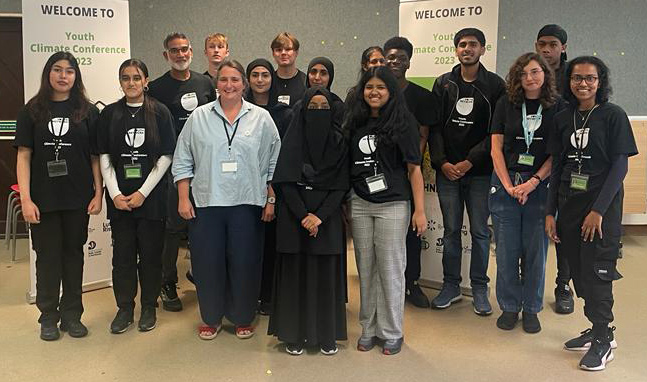
Travis Waller, from Luton Sixth Form, attended the 2023 Youth Climate Conference as a reporter. He shares his perspective on the two-day event for Luton’s young people.
Students began to arrive at Stockwood Discovery Centre around nine o’clock, where they were greeted with smiles from the staff. Children were given a name tag and a goody bag.
On the first day, three local schools attended the conference with their year 5s (aged 9-10). They went to two presentations on climate change, themed around food and transport. Day two was for year 9 (aged 13-14). These age groups were chosen as they are in a period of transition: the younger group will soon be choosing a high school, and the older year group is about to start their GCSEs. Inspire them now, and they can bring new environmental energy into those choices.
The day began with some brief opening presentations to explain the day and introduce the partner organisations. Then it was on to the workshops. I sat in on the one in the café, being taught by Youth Network climate ambassadors Warren and Hamnah. I was pleased to see the expression on the childrens’ faces and their willingness to engage.
The activity was to explore global land use, by the gradual placing of Lego pieces representing different biomes. The Lego base plate they were building on was a thousand blocks, which represented 100% of the earth’s surface. Children looked eager to learn and share their opinions. After a short break, part two of the food workshop saw the children finding their school on a large map of Luton. They also placed Monopoly houses to represent their own homes, and discussed where food comes from in the town.
After this was lunch. I was able to speak to a teacher at one of the schools and get her thoughts on the day so far. The feedback I received was very positive. She agreed with our choice of year 5’s, emphasising the importance of teaching younger children, giving them a good grounding in the problems and the good habits they can enact in their everyday lives.
In the afternoon came the transport workshop, with an introduction to modern transport presented by ambassadors Labiba and Simrah. This introduction led students through the Mossman Gallery, which features antique modes of transport throughout the years. They discussed the pros and cons of different ones, from horses to steam to cars, and the effect on the climate that they each have.
Back in the workshops, I was impressed with the energy levels. I expected a drop off in excitement and participation as the day went on, but I saw a high level of eagerness to learn.
At the close of the day I had a quick chat with some of the teachers, staff members, and students. One staff member said that they were initially wary of the unconventional activities, but thought it ended up being a great activity for the children, and they themselves learned a lot. The children I spoke to said it was very interesting and they learned so much, and they started to tell me all the facts they were taught.
Day two followed a similar programme, with the addition of a Q&A with six panellists from various sectors of environmental work around Luton. Participants could ask questions about what they had learned, or any queries about the environment in Luton more broadly.
I was thankful for the opportunity to attend the climate conference 2023, and to do this write-up. From what I observed over the two days, I was impressed by the job the team did, bringing young people to a place where they can learn about the climate and the difficult situation we are in if we do not make a change. The fact that the conference is executed by young people for young people is both refreshing and inspiring. It shows they want to make a change, and there is a new energy and passion about what needs to be done.
Street trees are an important form of climate change adaptation, as they provide shade and cooling during increasingly hot summers. They also add beauty and character to our streets, and clean the air. So we need our street trees, and we need to plant more of them!
Unfortunately, young trees are vulnerable to the same heat we hope they will protect us from. A well established tree is more resilient, but saplings can easily die during a hot and dry spell in the summer. The Woodland Trust and the Arboricultural Association have warned that newly planted urban trees don’t always survive their first three years, and are calling on people to water trees near where they live.
“Planting a tree is just the start of the story,” says John Parker of the Arboricultural Association. “The health and survival of new urban trees is threatened by increasingly dry weather. It is recommended that newly planted trees are given 50 litres of water per week during the summer months, for the first three years. You can help ensure healthy trees for the future over the summer months by watering trees near you.”
Some places have set up watering rotas in the neighbourhood, and some families have made it part of an after-dinner routine with the children. Other tips to consider:
Watering a tree in the morning or evening is best – more will evaporate if it’s done in the middle of the day.
Don’t let it stop you if the tap is all you have, but use rainwater from a water butt if you can. ‘Grey water’ is also fine for trees, the Woodland Trust assure us, so you can use washing up water or bathwater.
Eaton Green Tidy Tip will host Luton’s first pop-up re-use shop on Saturday 1st of July.
The shop will sell pre-owned goods donated at the town’s recycling centres, with homeware, toys, games and DVDs at bargain prices. All proceeds from sales will go towards local charities, raising money while reducing waste and carbon emissions.
The pop-up, which is run by Luton Council in partnership with FCC Environment, will be open from 10am to 3pm. Potential visitors might want to note that, as usual on the tidy tip, there is no pedestrian access.
Re-use is at the top of the waste hierarchy and the best thing to do with unwanted items. Along with charity shops, passing things on to friends and neighbours, or websites such as Freecycle, items can always be donated at recycling centres. To donate an item, just talk to the site operatives. Not everyone knows that things can be donated in this way, so the pop-up shop should raise awareness of re-use at recycling centres.
The pop-up shop is a first for Luton, and will be open for just one day. Other towns and cities have created more permanent shops, with Manchester’s Renew Hub being perhaps the most ambitious. Luton doesn’t have the size and scope to support a major project like Manchester’s, but hopefully the re-use pop-up is a sign of the re-use revolution to come.
The Eaton Green Tidy Tip is on Eaton Green Road, just round the corner from Asda. LU2 9RT.
What is a greener Luton going to look like? What does climate action in the town look like so far? We’d like to answer these questions with a photo gallery of environmental action in the area. It will be a collection of images that are free to use and solution focused, available for use in schools, reports, media – anyone that needs to illustrate a greener Luton.
If you’re a photographer – professional or amateur – with an interest in environmental themes, we’d welcome your contribution to the gallery. If you have press images in an existing collection that you’d like to add to ours, or links to them, please do get in touch too.













 Zero Carbon Luton