Carbon Literacy Training for Bedfordshire Schools

The Carbon Literacy Project has launched their first training package for school staff in Bedfordshire. Working in collaboration with HEART Academies Trust, Bedford Borough Council, Central Bedfordshire Council, and Luton Borough Council, it will run during these two dates in June:

·                  Wednesday 3rd June – 09:30 – 16:30 – central Luton (Location TBC)

·                  Monday 29th June – 09:30 – 16:30 – Borough Hall, Bedford

Central Bedfordshire schools are very welcome to attend either date/location. 

What is Carbon Literacy and why is it important to schools?

Carbon Literacy is a globally unique climate action initiative developed by The Carbon Literacy Project. To become certified as Carbon Literate, learners must complete a day’s worth of accredited training. This enables individual and schools everywhere to take meaningful climate action to enact the cultural shift necessary for the transition to a low carbon society.

This training offers solutions for

  1. Reduced energy bills and transport costs
  2. Improved employee morale, satisfaction, and productivity
  3. Enhanced image and credibility
  4. Up-to-date knowledge and information for your staff and students
  5. Support your Carbon Action Plan and School initiatives

Who can attend?

The training is suitable for all members of school and Trust staff, including school governors and Trustees. Sustainability is achieved as a team, therefore we welcome Senior Leadership, Business Leads and School Maintenance staff, as well as teaching staff. The training will be delivered in person.

What do previous attendees think of the training?

After a successful pilot training session at Arnold Academy in January, where staff from 11 schools across Central Bedfordshire and Luton joined together for a day of learning and climate action planning, participants said:

I was impressed by how informative the session was. The leads were knowledgeable, provided practical advice and encouraged us to think about how what we’d learnt might apply to our settings.”

“I enjoyed hearing how the issues can be tackled from making small changes. It was very relatable to our lives and everyday activities.”

This training opportunity is free for schools in Bedford Borough, Central Bedfordshire, and Luton. Places are limited so book soon to avoid disappointment. To register, please email your local authority with the following information:

  • Full Name
  • School Name
  • Job Role
  • Date you would like to attend

Bedford Borough:  Energy.Team@bedford.gov.uk

Central Bedfordshire: BeGreen@centralbedfordshire.gov.uk

Luton: myclimate@luton.gov.uk

Please state ‘Carbon Literacy for Schools’ in the email Subject Header.

Catch up with Luton’s green schools

The Climate Action Teacher Champions programme ran for five cohorts and 33 schools, inspiring a wave of environmental action in Luton’s schools. With the programme now closed, the council have produced a series of videos to capture what was learned. The videos feature students and staff from three participating schools: Ramridge Primary, Whipperley Infant Academy and Chiltern Academy. Here’s the introductory video, with more detailed case studies of each school available here.

Luton was ahead of the pack in helping its schools to develop a climate action plan. For schools that were not able to take part in the CATCH programme, there is plenty of support available elsewhere, including Let’s Go Zero and Climate Ambassadors.

New food waste collection on its way

Changes to recycling and waste in Luton will begin this year, including the significant addition of separate food waste collection. Caddies for food waste, and instructions for using them, will be delivered towards the end of February. The new collections will then begin in late March.

Food waste collection was temporarily trialled in the Barnfield and Saints wards in 2019. Participation rates were 44%, which is above average nationally. The trial was extended for a further six months, before being overtaken by the Covid-19 pandemic and a lack of funding.

New government guidelines have since been introduced that require separate food waste collection across the country. The new rules were initially set in motion under the Conservatives in 2023, aiming to reduce the ‘postcode lottery’ of different waste practices between councils.

Drawing on best practice from those who already run collections, the guidance stipulates that collection should be weekly, and that households should have two bins: a smaller one to keep in the kitchen, and a large one to take to the kerb. The larger ones have lockable lids to keep animals out.

Alongside food waste, glass collections will change from monthly to every two weeks. Existing schedules for general waste and recycling will stay the same.

These changes will hopefully raise glass recycling rates in the town, and reduce food waste overall. Previous studies have shown that up to 40% of Luton’s black bins was food waste. Separate collection will prevent this organic material going to landfill or incineration, and will redirect it to become fertiliser or for use in biogas instead. This is a more environmentally friendly solution, though it is more expensive.

Benefits to households include greater awareness of food waste, and the opportunity to save money by reducing it. There should also be a reduction in mess and odours, as food waste previously put into black bins was only picked up every fortnight.

For more detail, see the Simpler Recycling pages on the council website, and look out for your caddy delivery in the coming weeks.

The Keech Solar Legacy Project

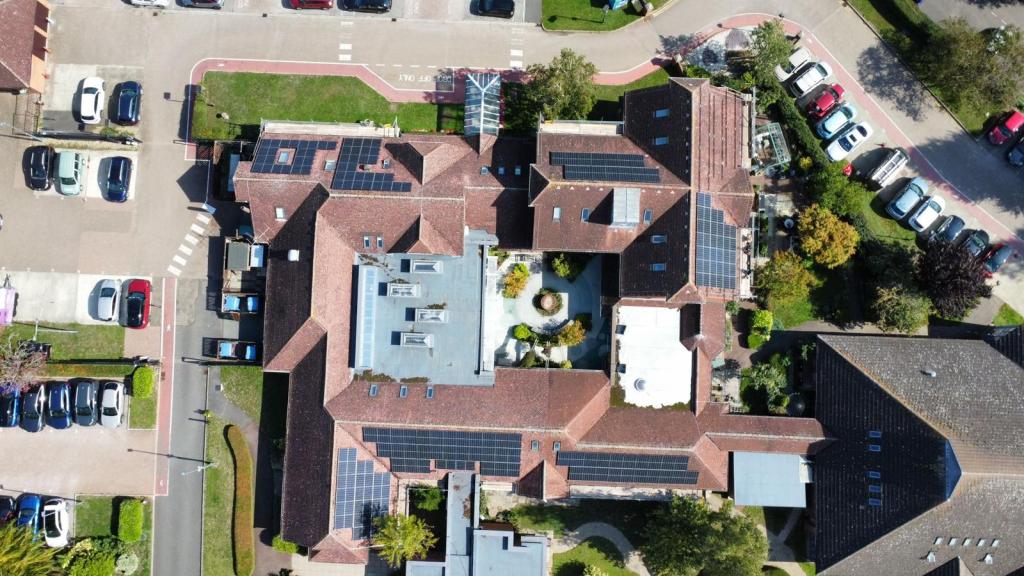
Keech Hospice is a well known charity in the area, supporting terminally ill children and adults and their families across the region. It’s also the beneficiary of a unique solar project, one of the largest in the town, and a model for community solar that is the first of its kind in the UK.

The project began when Eddie Doherty of Renewable Edtricity Systems was introduced to representatives from Keech at an event. They told him how rising energy prices affected their charity, and it set Doherty thinking about what he could do. “Not knowing what was ahead of us, we went back to them and said we’ll install something for free for you.”

This rapidly became a collaborative effort, as “it would have been an uphill struggle with square wheels if we had tried to do it on our own,” as Doherty puts it. What followed was “a lot of begging, many, many hours of designing, of liaising with Keech,” and slowly a team came together. Business connections led to a donation of 504 panels from Astronergy, while another major solar supplier, Clenergy, donated the bars and clips for mounting the panels.

Without the support of these national suppliers, “there would be no project at all”, says Doherty, but it would take a lot more teamwork to carry out the install. At the local level, support first began to come in from Irish construction companies in Luton, including Capital Sky who are currently working on the new Luton Town stadium. Companies offered support in kind, such as scaffolding or the use of a fork-lift hoist. Others lent staff time, sending teams to work on the electrics or the panel installation.

Some of these companies would normally be in competition with each other, but found themselves working side by side on the roof of the hospice. “We’ve got some of the UK’s biggest suppliers, wholesalers, and they’re all working together,” says Doherty. “It’s a unity between giants of the sector that would normally be – not at loggerheads exactly, but certainly in healthy competition. They’ve put that aside, and what better way to come together than for Keech?”

When the installation is complete by the end of November 2025, it will be an array of 504 solar panels. That will save Keech a significant amount of money, estimated to be worth 50 to 60 thousand pounds a year for the life of the panels. “Lower energy bills mean we can reinvest that saving directly into specialist compassionate care for children and adults with life-limiting conditions in our community,” say Keech.

Luton Town’s sustainable new kit

Do Luton Town have the most environmentally friendly football kit in the country?

Quite possibly. This year’s kit is the first made by Reflo, a sustainable sportswear company. It will use their Reloop fabric, which is made of recycled polyester and is in turn fully recyclable. It means the kit can be taken back and processed into new polyester at the end of its useful life.

The club say it’s “a meaningful solution to the 92 million tonnes of textiles that end up in landfill each year, transforming shirts into a circular product that can be reborn season after season.”

Reflo are signed up for three years, and are making the away and third kits too. All of them have been designed in collaboration with the Luton Supporter’s Trust, ensuring that the material innovation still honours the club’s tradition and branding.

This isn’t just a first for Luton, it’s a first for football. No other team has a shirt with environmental credentials like this one. Not even Forest Green Rovers, often hailed as the greenest team in the land. Admittedly they may be about to unveil a new kit with Reflo too, but Luton have beaten them to the announcement and get to say they were the first.

The recyclable shirts are part of Luton Town’s rather impressive commitment to sustainability, with the new stadium due to be among the greenest in the country.

Pupils share tech innovations for a better world

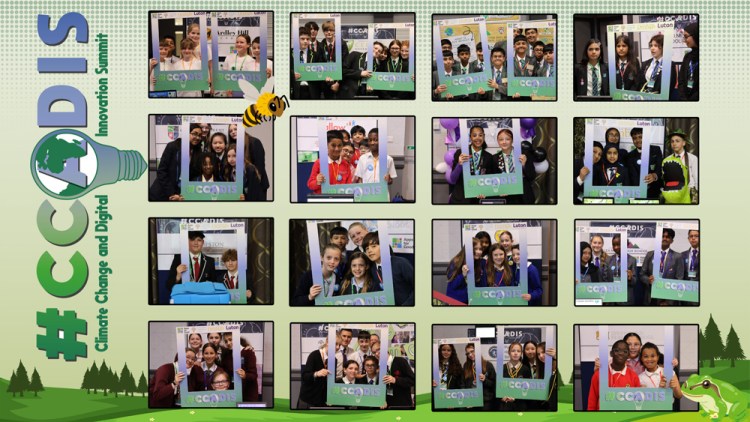
Students from across Luton and the region have taken part in the Climate Change and Digital Innovation Summit, presenting their work on environmentally themed apps. Teams from 16 schools in the Chiltern Learning Trust met at Venue 360 to display their apps, give demonstrations of their tech, and hear from other young coders and tech professionals.

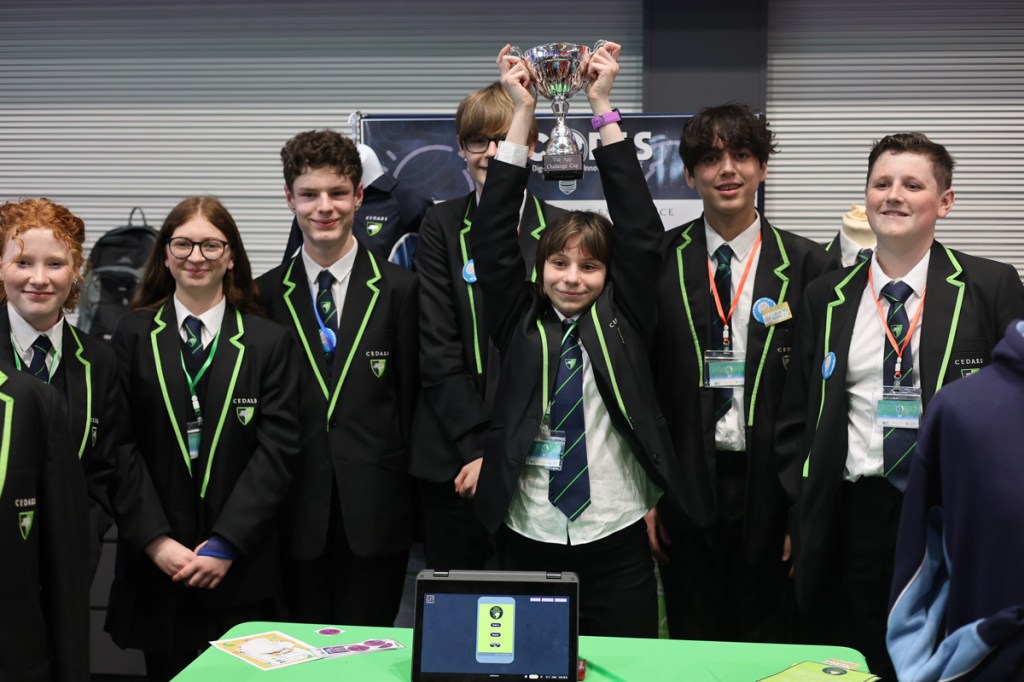
Each team presented their app from the stage and at a stand in the hall, with visitors and experts voting for a favourite. The winning project was Cedars Upper School with an app called Cedars Uniform Marketplace. The team identified the multiple benefits of reuse as a climate action: reusing school uniform reduces waste, and also builds community and saves families money.

Marston Vale Middle School created an app to help their teachers cut down on paper use and took second place. Third place went to an eco-art app developed by a team of girls from Lark Rise Academy, which creates artwork and music from walks in nature. Sophie and Grace, both in year six, developed new skills in working together as a team, and found new confidence in presenting their app. “I was kind of scared to go on stage, and then when I was on, it was fun,” says Sophie. “I loved talking to everyone about our idea.”

Among the other projects were apps that educate users on deforestation or recycling. The team from Chiltern Academy focused on food waste and the benefits of composting. Lea Manor High’s wellness app helped people to draw the connections between their own health and the health of the planet.

The Climate Change and Digital Innovation Summit, now in its third year, is organized by Denbigh High School, the Chiltern Learning Trust, and Apps for Good. Students use lessons from the tech education charity Apps for Good, along with their app development platform. Some take part in the programme during computing lessons, others as an extra-curricular activity. The winning team from Cedars High School meet as a lunchtime coding club.

For an organization that mainly works online, the event has become a fixture in the calendar for Apps for Good. “The best bit is hearing students so confidently sharing their ideas with our industry volunteers and getting real life feedback,” says Natalie Moore, CEO at Apps for Good. “I feel reassured that our future is in good hands with these inspiring young people, and excited about the app ideas they’ve come up with to combat climate change.”

Apps for Good work with over 28,000 students every year, challenging pupils to take on a tech project that tackles climate change or a social issue. With lessons exploring the problems and practical tools for building solutions, pupils develop working prototype apps that could make a difference in their community. The programme nurtures skills in two key areas of the economy, green jobs and the tech sector.

“The inspiring innovation we saw from students of all ages at CCADIS underscores the vital importance of this work,” says Emma Darcy, Director of Technology for Learning at Denbigh High School. “By using tech to tackle climate change and social issues, these young people gain crucial digital, oracy, and problem-solving skills. This not only opens doors to sustainability and technology careers, but also empowers them to actively address their concerns and build a more climate-conscious future.”

Luton’s efficient social housing

Luton is in the top ten towns in the country for energy efficient social housing, according to a study from U-Switch.

The study looked at average Energy Performance Certificate (EPC) scores across all 317 local authorities in England, Wales and Scotland. In first place was Exeter, where the average EPC was 82, with 14% of their social properties scoring an A. Exeter has been a national leader on Passivhaus standards, which is one of the leading design codes for creating homes with low energy needs.

Luton squeaked into the top ten at number 10, thanks to an average EPC score of 73.6. It shows a commitment to energy efficient homes, and lower bills for Luton residents in council houses. There’s more to come too, as visitors were able to see at the retrofit open house that ran for several weeks in 2023. There are plans for further improvements to insulation, heating controls, and low carbon heating sources.

Drop in on the repair cafe

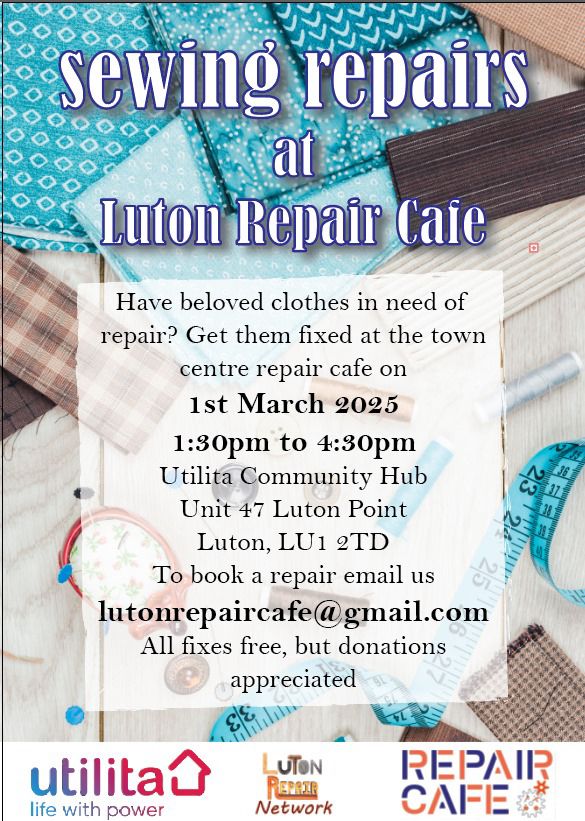
After a succesful pilot last year and a clothing repair session at the Utilita Hub, the repair cafe returns on the 1st of March. Drop to Utilita in the mall on the afternoon of March 1st and experts will be on hand to help repair clothing and textiles.

Keep up with future events by following Luton Repair Network on Facebook. See the Repair Cafe website for more on this international movement, and read Julie Furnivall’s article here for how people are bringing it to Luton.

A call to action on fly tipping

Tamar Lovindeer-Robinson writes:

“One hand can’t clap” – Jamaican Proverb

This timeless Jamaican saying reminds us that collective effort is the heartbeat of progress. Fly-tipping, the illegal dumping of waste, is not only an affront to the beauty of our shared spaces but also a stark warning about what happens when responsibility falters and we fail to work together.

The Environmental Toll of Fly-Tipping

Fly-tipping scars the environment with devastating consequences. Harmful chemicals leach into soil and water systems, endangering wildlife and ecosystems. Piles of discarded waste attract pests, contribute to air pollution when burned illegally, and block drainage systems, causing flooding. What’s worse, these acts of neglect are not isolated—they set a precedent for more dumping, fostering a culture of disregard for the natural world.

In Sikh teachings, Guru Nanak said, “Air is the Guru, Water the Father, and Earth the Great Mother.” When we pollute and abuse these sacred elements, we jeopardize not just the environment but the very essence of life that sustains us. The next generation—those little ones walking among us today—are inheriting a planet poisoned by inaction. What kind of legacy is this?

The Ripple Effect on Community

When elders show disdain for their surroundings, it sends a toxic message to young people: “Your space doesn’t matter, and neither do you.” This disconnection breeds disengagement. Fly-tipping and neglect alienate young people from their environment and heritage, leaving them feeling unattached to the streets, parks, and public spaces that should be sources of pride and inspiration.

It’s not surprising that these feelings of disassociation can lead to deeper divides—social and emotional. Imagine a cricket pitch strewn with garbage; it’s no longer a place to practice the artistry of the game, to hear the satisfying crack of bat against ball, or to connect with teammates. Disheveled surroundings extinguish joy and community spirit.

Transforming Ugly Eyesores into Pride

It doesn’t have to be this way. Across the globe, the most breathtaking destinations remind us of the power of human care and collective pride. Think of the serene Masuria lakes of Poland, the Himalayan peaks of Pakistan, the Sundarbans mangroves of Bangladesh, Jamaica’s lush Blue Mountains, Ghana’s Kakum National Park, Nigeria’s Yankari Game Reserve, and the Lake District in the UK. What do they all have in common? They are spaces nurtured by communities who understand that beauty inspires and sustains us.

In Luton, we can take a page from their book. Swift action to tackle fly-tipping, whether through communal clean-ups or lobbying for better waste management infrastructure, can have transformative effects. Beautification projects such as community murals, greenery planting, or restoring cricket pitches can turn “eyesores” into vibrant places of pride and connection.

A Call to Action

To all passionate, transformative people—regardless of age or background—this is your moment. The fight against fly-tipping is not just a task for the council or environmental agencies. It’s a mission that calls on us all to become caretakers of our shared spaces.

Plant a flower where trash once lay. Call out bad behavior when you see it. Rally your friends and neighbors to clean and beautify the neglected corners of your community. As Sikh wisdom reminds us, “When the hands are united, what work cannot be accomplished?”

The world is a cricket match, and every individual has a role to play in ensuring our fields are green, our skies are clear, and our communities are strong. Let us honor our elders by respecting the earth they leave behind and inspire the young by showing them how beautiful their future can be. Together, we can create a Luton—and a planet—worth loving.


About the Author

Growing up in an area plagued by fly-tipping, I’ve witnessed firsthand how illegal waste disposal destroys the beauty of a community. The mountains of rubbish, unpleasant smells, pests, and obstructions have been a persistent reminder of the harm this neglect causes—not just to the environment but to the people who live there.

Determined to make a difference, I’ve channeled my passion for environmental action into creating Red Hand, a crime-fighting character armed with a red workman’s glove, symbolizing a rallying cry against those who harm our environment. Through Red Hand, I aim to inspire others to stand up for the spaces we all share and protect the beauty of our communities.

I’m especially proud of Luton’s beautiful Green Flag parks—Brantwood Park, Leagrave Park, Memorial Park, People’s Park, Stockwood Park, and Wardown Park. These incredible spaces represent the best of our town, earning recognition from the prestigious Green Flag Award as some of the finest parks and open spaces in the UK. They are a source of pride for Luton, and it’s vital we work together to keep them and the rest of our environment clean and welcoming.If you’re passionate about making a difference, I invite you to join Luton’s Very Own (LVO), a growing community of environmental advocates. Follow us on Facebook (227 members strong), Instagram (168 followers), and Patreon to stay updated and get involved. Or, better yet, join the conversation and action on our Discord server, where passionate locals are uniting to transform our town for the better. Together, we can create a cleaner, greener Luton.