Do children play on the street where you live? If so, lucky them! Traffic has made most streets in Luton unsafe for play, which keeps children indoors and affects their health and wellbeing. Adults have take too much public space and use it for their cars.
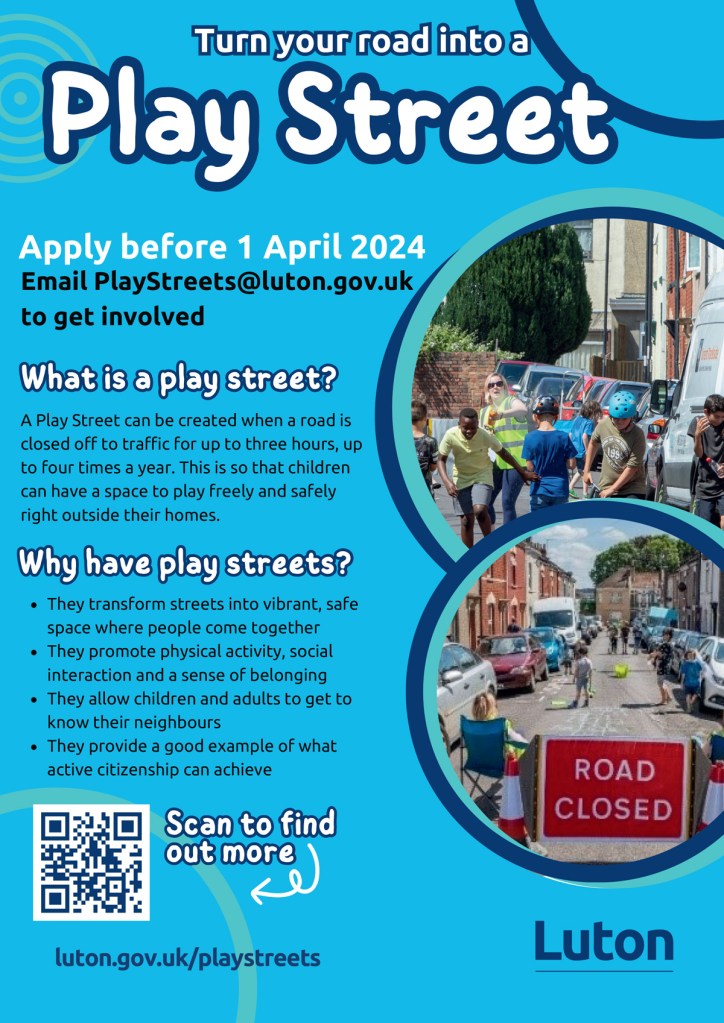
If you’d like to help reclaim outdoor play for children, you might want to look into hosting a Play Street this year. This would see your road temporarily closed to traffic – like many were for street parties during the jubilee. Children would get three hours to run wild in the street, four times a year. Chalk on the road, blow bubbles, ride bikes, etc.
Play Streets are a citizen-led scheme, which means the council can’t do it for you. What they have done is simplified the application process for closing a street, making it easier than ever before. If you’d like to give it a try in the summer holidays, now is a good time to start planning for it. The council need 12 weeks notice and need an application in by the end of April, so talk to your neighbours and parents’ networks soon if you’d like bring it to your street in the summer.
Play Streets are obviously a nice thing in their own right, but there’s also a climate connection. They challenge the dominance of car culture, remind us of what we’ve lost in giving so much over to the car, and hint at an alternative future. We can’t solve climate change without a new approach to transport and travel, and in re-negotiating our relationship with traffic we might find gentler, safer, more playful streets too.
The second round of the Climate Action Teacher Champions programme has now concluded, with six more teachers trained and delivering a climate action plan for their school. Mayor of Luton, Councillor Yaqub Hanif, handed teachers their certificates in our final meeting, hosted at Stockwood Park Academy.
“It was a really enjoyable programme,” said Raheela Saleem, a science teacher at Challney High School for Girls. “I love the fact that we got to meet other people from different schools, and networked and shared ideas with each other.” As part of its response to the environmental challenge, the school is installing a greenhouse, investigating solar panels, and involving students in an eco-team.
Schools are invited to join the third round of the CATCh programme, which starts at the end of January. You can find out more about it here.
For teachers considering joining, “why wouldn’t you?” says Andeep Birring from Chiltern Academy. “There’s no better way of finding out how you can be a positive influence.”
Bedfordshire University continues to rank among the greenest in the country, coming 3rd in the annual league from People and Planet. Out of 151 in the league, only Reading University and Manchester Met score higher.
Beds has been among the top universities for several years, scoring first place last year. It reflects an ongoing focus on sustainability throughout the institution, and the university scores highly on environmental policy, carbon management, sustainable food and water.
“This sustainability league table position is the culmination of more than 10 years’ work,” notes Adam Higgin, Head of Sustainability at the University. Over those years, Beds Uni has worked on increasing recycling rates across the campus, improving water efficiency and reducing carbon emissions.
The university runs on 100% renewable energy, much of this sourced from its own solar panels. There are five solar arrays, the largest of which is on the roof of the library (an award-winning sustainable building in itself, by the way). Together, these five solar systems have generated over a million kilowatts of clean energy, a milestone that was passed this year.
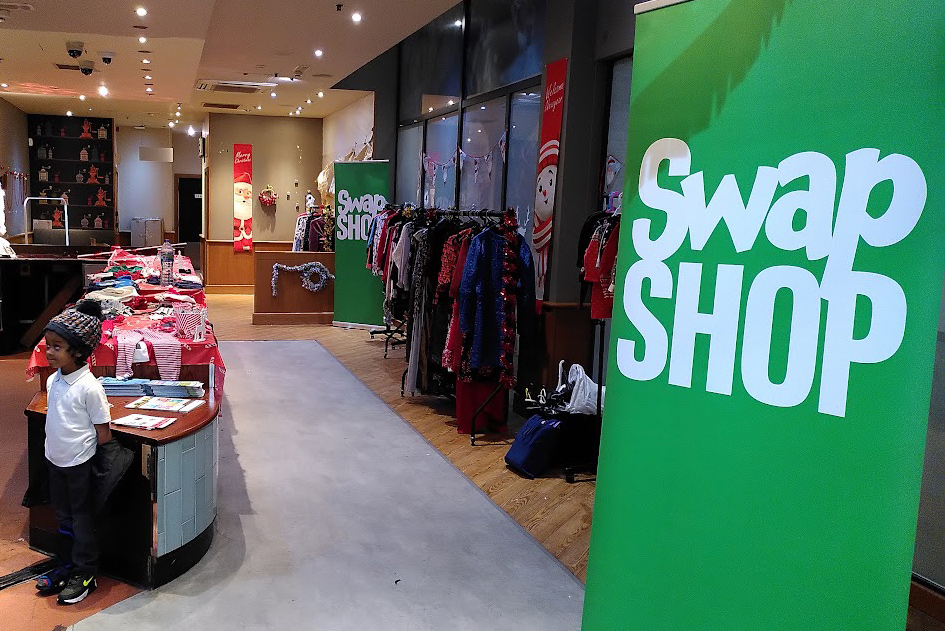
A pop-up Swap Shop will open on Saturday 16th of December in the Mall, Luton. There’s a festive theme to the swap event, and an opportunity to find something new for the Christmas season – adult and children’s partywear, festive tops, jumpers and accessories.
People have been dropping off outfits and items already, so that they can be checked and sorted. Contributors receive a ticket in return, and that can be redeemed for a new item when the Swap Shop opens on Saturday. You’ve still got time to drop something off between 10am and 12pm on the 14th. You can simply donate items as well as taking part in swaps.
Organised by the council waste team, the Mall, FoodFirst and LutonKind Kids, this is the first Swap Shop, or Swish, to take place in the mall. Previous clothes swaps have been held in other locations, including the Hat Factory. Swapping is a great way to keep clothes in circulation, prolong their life, and refresh someone’s wardrobe without having to buy something new. So it’s a green solution as well as a fun community event.
When I dropped in this week, there was a steady stream of curious shoppers ducking in to see what this new shop was on the corner just along from the Tesco. Christmas decorations were going up ahead of the main event, some of them made from recycled materials. There was a bright selection of children’s jumpers and pyjamas, and a rack of dresses. Menswear was in short supply, as usual for Swishing events (come on gents!)
There are plans to host a regular series of swapping events throughout the year, as the community discovers the Swap Shop and how easy it is to take part.
The Climate Action Teacher Champion programme is now recruiting for round three, starting in January 2024. If you are a teacher, consider yourself invited – or nominate a colleague! If you’re a parent or a student, tell your school about it and get them involved. Send them a link, or download and send the flyer below.
The scheme has already worked with a dozen schools in Luton to train teachers and develop climate action plans. Participating schools have gone on to found eco-teams, draw up plans for new gardening areas, and introduce new ideas to reduce food waste and boost recycling. There are two roof-gardens in the works, as well as new and renovated ponds, wildflower meadow and tree-planting plans. At least one school is investigating solar panels to reduce costs and carbon emissions.
“Most of what we’ve focused on is improving our school environment,” says Sam Clarke from Wigmore school, who took part in round one of the CATCh programme. “Our whole outdoor area needed a refurb, to cut pathways through, to do some wildflowers, to increase biodiversity. We have a pond but it’s dried up and it’s just a concrete shell, so that’s getting fixed and lined. We’ve got a lot of ideas, and it will take a year to work through them, but in the end it will be such a nice place for the children, for them to come outside and learn about their environment, about biodiversity, and to really care and make a difference.”
The CATCh programme consists of six weeks training, in both online and in-person sessions. This happens with teachers from other schools, as part of a learning community of like-minded educators. Teachers then work on a one-to-one basis with an experienced facilitator from one of the partner organisations, and develop a climate action plan for their specific context. It brings all the many options around sustainability into a practical and manageable plan. Participating schools also receive a £1,000 grant to get them started on their eco actions.
Teachers from round two are finished the programme and completing their plans by Christmas, with round three now recruiting. To join the scheme, please email myclimate@luton.gov.uk
The council has launched a retrofit open home for the Autumn, and is inviting visitors to tour the property and see some low carbon technologies for themselves.
The house is a three bedroom family home on Abbotswood Road, Round Green. Over the summer it was retrofitted to low carbon standard, in partnership with Luton Rising. It features a number of points of interest for those looking to reduce both their carbon emissions and their bills:
Solar panels and storage battery
Heat pump
Heating controls
Insulation and triple glazed windows
Compost demonstration
Open the cupboard under the stairs, and you will find the building’s gas pipe, now closed off and capped. This is an all-electric home, powered by the solar panels on the roof. The batteries, also under the stairs, capture solar power to use at night, and the system can provide around three quarters of the home’s electricity needs.
Step into the garden and visitors can see compost and leaf mould demonstrations, courtesy of Edible High Town. They have also added a little sign drawing attention to the ‘energy-saving solar and wind powered clothes dryer’, known to you and I as a washing line and proving that not all green tech is high tech.
Against the back wall visitors can see the heat pump, gently whirring. (You may have read the recurring complaints online that heat pumps are noisy – come and listen for yourself!) The heat pump captures warmth from the outside air, even in low temperatures, and pipes it into the boiler. That then supplies the radiators.
Because it uses heat from the environment rather than burning fuel to create warmth, heat pumps are very efficient. In this house, it’s also being powered by the solar panels and this will mean very low bills for future residents.
Those future residents are expected in mid-January, so there is a limited time to visit the show-home. With a housing shortage in Luton, a council house can’t be kept empty for long, so visit it while you can.
As well as demonstrating the technologies to interested people, the home is also a way of testing those technologies in a council home. Luton has just under 8,000 council homes of one kind or another. Moving them towards low carbon will help to meet our climate targets, but it will have lots of other benefits as well.
“We’re taking a start to finish approach to sustainable housing,” said Dylan Katuwawala, Principle Climate Change Office at the council, as he showed me around the house. “That begins with upskilling and green jobs to deliver retrofits, and results in warmer homes and lower bills for residents. It will reduce our carbon emissions with all sorts of co-benefits along the way, from improved health and wellbeing to addressing fuel poverty.”
Community gardener Konni Deppe tells the story of Luton’s fruit trees and orchards, and an inspired idea to use up surplus apples.
The problem
Do you know of an apple tree near you where the fruit doesn’t get picked? You’re not alone.
Surprisingly, many fruit trees in Luton’s back gardens and public places go unharvested. Fruit will still provide food for birds and insects, but some of it ends up in people’s brown or even black bins, and make its way into landfill or incineration, adding to our CO2 emissions.
At the same time, many people have lost a connection to our rich orchard heritage. Over centuries, more than 2,000 varieties of apples have been bred in England alone. However, modern varieties are grown for appearance, and ease of picking, storing and shipping, rather than flavour. Today’s supermarkets only offer a tiny selection of apples, often imported. The last greengrocer in Luton who sold local varieties, Round Green Fruiterers, closed more than 6 years ago.
Trees can produce a ‘glut’ of fruit over a few weeks and then nothing for the rest of the year. Today’s households are often not geared up to preserve or store them, nor do people have the time, so it’s easy to see why going to the supermarket can seem like a convenient alternative.
The idea
One of the easiest ways to deal with the excess fruit is to turn it into juice or cider.
Inspired by a similar project in nearby Hitchin’s Triangle Garden, I wondered whether I could collect this fruit and turn it into apple juice instead. So the Luton Apple Amnesty was born.
Apple amnesties are an idea that’s been around for a while. Many towns and villages across the UK and Europe are making their own apple juice from local crops.
Apple Amnesty – how it worked
To test the process from tree to bottle, the Edible High Town team and I produced a very small batch of juice last year. We offered a tasting event at St Matthew’s Primary School. People absolutely loved the juice, and it was sold out by Christmas.
This year, to be able to scale up, we joined forces with the social gardening project Penrose Roots and applied for a grant from Love Luton to help us pre-finance the juice.
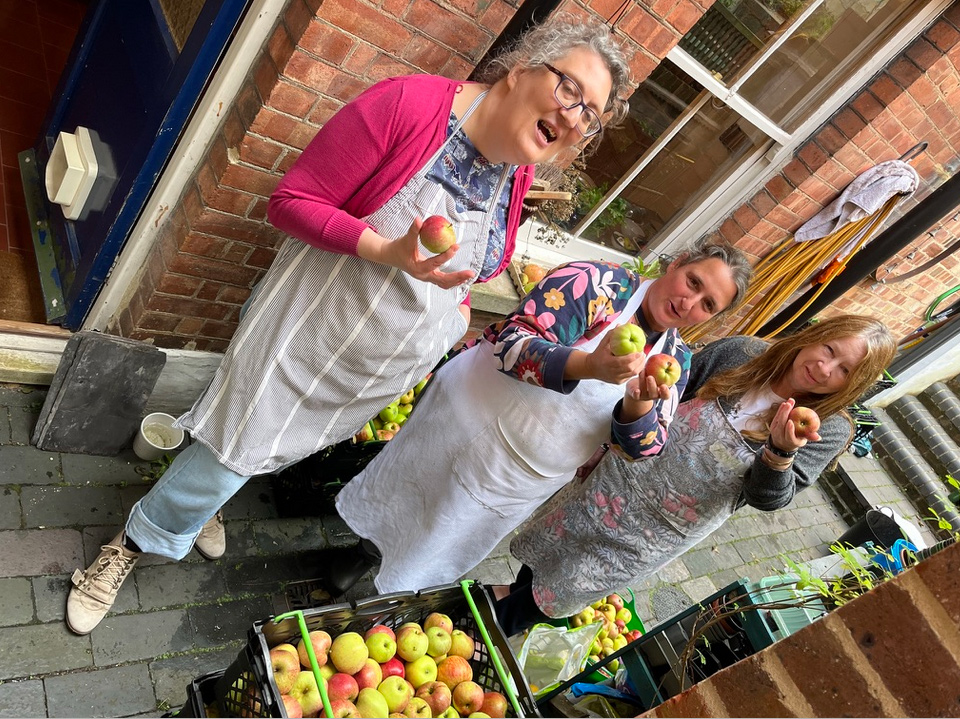
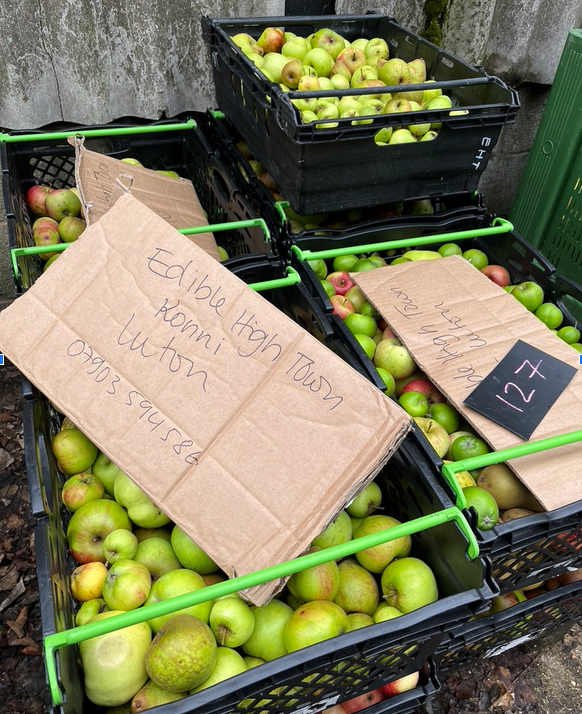
We had two drop-off locations where people could leave their harvest on specific days in October. For people who had a lot of fruit but couldn’t harvest or drop it off themselves, we did ‘home visits’ and picked them straight from their trees.
We found that some fruit trees were surprisingly bare this year, which may have been due to the late frosts in spring. This shows that the more varieties of fruit trees we have, with early and late-blossoming types, the more resilient we’ll be, no matter the weather.
We supplemented garden apples with harvests from local community orchards, and fruit from places such as Grasmere Nursery School (yes, this school has its own orchard!), Luton Hoo Walled Garden, and the Stockingstone Road Allotment orchard.
Volunteers checked the donated apples for quality and to ensure a good mix of ‘cookers’ and ‘eaters’. Together with Penrose Roots we organised the transport to Apple Cottage Cider press in Radwell, who professionally pressed, pasteurised and bottled our local crop.
In total we had 18 donations racking up 250 kg of apples, resulting in 227 bottles of delicious juice. The finished drink stores for 18 months, extending the time people can enjoy local produce.
In the process we discovered several heritage varieties growing people’s back gardens from Laxton’s Superb and Worcester Pearmain to more obscure cultivars that we’re still in the process of identifying.
Local designer Jenna created a label which includes the names of the apple varieties in the juice. Look closely at the bottle, and you can even see the Luton skyline in the background!
Each donor who contributed more than 10 kg of fruit will receive a free bottle, and we’ll give some away to our helpers and donate some to good causes.
The remaining bottles will be sold to help fund orchard activities in Luton such as pruning courses this winter. The juice is available at a suggested donation of £4 per bottle, for example at the High Town Christmas Market on 1 December.
More than juice
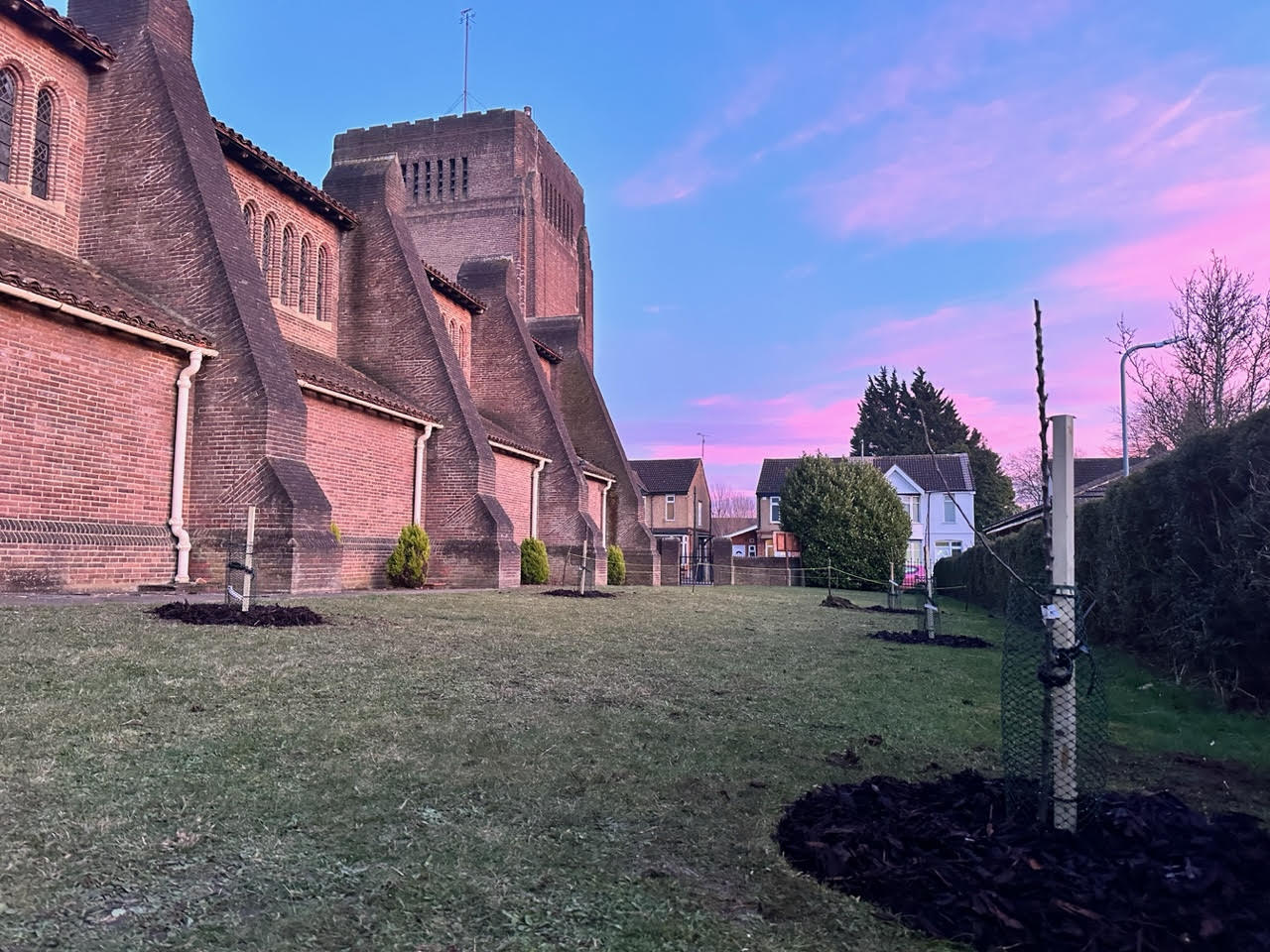
The Luton Apple Amnesty is one piece of a wider project with the aim of turning Luton’s fruit trees and community orchards into productive, wildlife-friendly places that are loved by the community.
In the long term, a great achievement would be that no fruit goes to waste in Luton, that community orchards and garden trees are well cared-for, and that no fruit tree is felled where it could have been restored with careful pruning.
We share our work with regional and national organisations, to show off the best of Luton and its orchards. We are already connected to the Bedfordshire and Luton Orchards Group (BLOG), the East of England Apples and Orchards Project (EEAOP), and the Orchards East Forum (University of East Anglia).
You can support the work by buying local apple juice, donating fruit from your tree, or volunteering with many fruit-tree activities. For more information and contact, visit: www.lutonorchards.org.
Green Hubs are regular meetings for those interested in environmental action, and there are lots of them around the country. Luton doesn’t have one at the moment, though there have been similar ideas in the past. Shall we put that right?
Luton Friends of the Earth and other groups in the town are hosting an inaugural Green Hub meeting at High Town Methodist Hall on Thursday the 9th of November, 7pm to 9pm.
The meeting will be a place where “local green and community groups can meet and plan joint activities,” says Mike Oliver. “One project will be to have a meeting where we ask general election candidates what they will do to improve things in Luton, for the people and our environment. Come if you can.”
There’s always more going on in the area than most of us know about, so come along and hear what others are up to. Meet like-minded people, and help to plan some actions and events together. Please share and spread the word, and hopefully see you there.
After a life at sea driving cruise ships, Jesse Bryce now works in energy efficiency in the cargo industry. He shares how he made his ex-council Luton home zero carbon for £4,200.
Decarbonising my home started not from what I should do, but from what I could do. By taking one step at a time, the gas supply has now been disconnected and capped off.
When I bought my house I had simple gas hobs. A nightmare to clean, and of course the windows fogged up every time I used them. That moisture on the windows indicated more moisture in the air – making it harder to heat the house too!
With a supply already wired to my kitchen, an electric induction hob was an easy choice, and a Bosch 4 ‘burner’ cost me £400 installed. It heats up faster, the kitchen stays cooler in summer and the only steam is from the food – not all the gas being burned. Better for cooking, easier to clean, and better indoor air quality too!
One of the most talked about aspects of decarbonising homes is our heating. The standard approach in the UK is to plumb an air-to-water heat pump into our radiators, circulating warm water as we’ve done for decades. To work well, it needs a well designed system to ensure the heat pump, the radiators and the pipes that connect them all meet the needs of our homes. Even with all that done right, for a smaller home like mine even a small 5 kW heat pump is still too large!
I was raised in New Zealand, where gas grids aren’t as common as here in the UK. Kiwis moved to adopt air-to-air heat pumps, often known as air con units! These are simple, cheap, quick to install units that are often more efficient at heating than their air-to-water counterparts.
For £2,000 installed, a single 3.5 kW Mitsubishi air con unit in my living room pushes more than enough heat through my home, ticking over low and slow to maintain temperatures. Most of the time I don’t notice it’s on, though when we hit minus seven outside the warm bubble around my couch was nice!
Because it’s pushing warm air into the area, I find it’s better at keeping my living room comfortable than my radiators ever were – all their heat seemed to disappear straight upstairs. And an extra bonus, no more creaking radiator pipes waking me up!
Having sorted my heating, it left my gas combi boiler only producing hot water. The step to take the boiler out was a bigger one – it meant I couldn’t use my radiators even if I wanted to. With the heat pump handling last winter’s cold spell so well, I had the confidence I needed to make that leap.
A basic hot water cylinder with a smart immersion switch gave me the best balance of cost and capability, at £1,800 installed. Being able to set a schedule on the immersion makes the most of cheap off-peak power overnight.
These three steps with a total cost of £4,200 meant I could have my gas meter removed – no more standing charges! And with smart meters and their off-peak tariffs giving running costs similar to (or less than) running on gas this last winter, going fossil free makes sense for bills too.
Living in an ex-council house, there are likely hundreds of homes in the area with similar heating needs and available space to repeat these steps. Some may still have a hot water cylinder, making it an even easier change!
Unfortunately there’s no help to make these changes at the moment. The Boiler Upgrade Scheme heat pump grant of £5,000 can’t be used for air-to-air heat pumps, even though that amount could enable hundreds (thousands?) of smaller homes just like mine to go fossil free – for free!
Seeing work in my local area to replace aging gas pipes, should we be digging up our streets again? Or perhaps helping get homes off gas is a better use of our money.
I’ve been lucky to be in a position to take these steps over the last few years, especially with the current cost of living. Hopefully by showing some of what we could do with our smaller homes, it can spark ideas for those wondering what steps they can take when they’re able to.
Applications are open for the next set of teachers to join the Climate Action Teachers Champions (CATCh) programme, ahead of the autumn term.
The scheme supports schools to develop a climate plan, offering training and one-to-one mentoring for teachers as they look at setting climate goals for their school. It is run by Luton Council, along with Groundwork East and Youth Network. Zero Carbon Luton is supporting the scheme with resource pages for schools.
All schools, primary and secondary, are invited to nominate a climate action champion from the school staff who will develop the school’s climate action plan. The plan will look at curriculum, school buildings and grounds, food, waste, and opportunities for students to get involved.
“Taking part in the CATCH programme has been hugely beneficial to myself and the school,” said one participant, Cameron Davies from Denbigh Primary. “The programme offered a fantastic team of experts that enabled me to create an action plan that suited our environment, while drawing on their knowledge for advice and recommendations to advance the schools sustainability. I would highly recommend attending the course to create a more positive outlook on sustainability within your school.”
If you’re a teacher in the town and want to take part, here are some practical details: The programme runs over eight weeks, with a mixture of in-person and online workshops and one-to-one meetings in school. Sessions run for around two hours, on Wednesday afternoons. The first session will in in person on Wednesday October 4th.
You would be supporting in developing a draft school climate plan by the end of December 2023, with a £1,000 bursary for the school on completion.
The programme was piloted last term, and proved to be a rewarding experience for participants. There were opportunities to learn from other teachers as well as environmental professionals, with a vibrant exchange of ideas and enthusiasm for engaging students and bringing climate action into schools.