Luton climate activist jailed for Insulate Britain protest

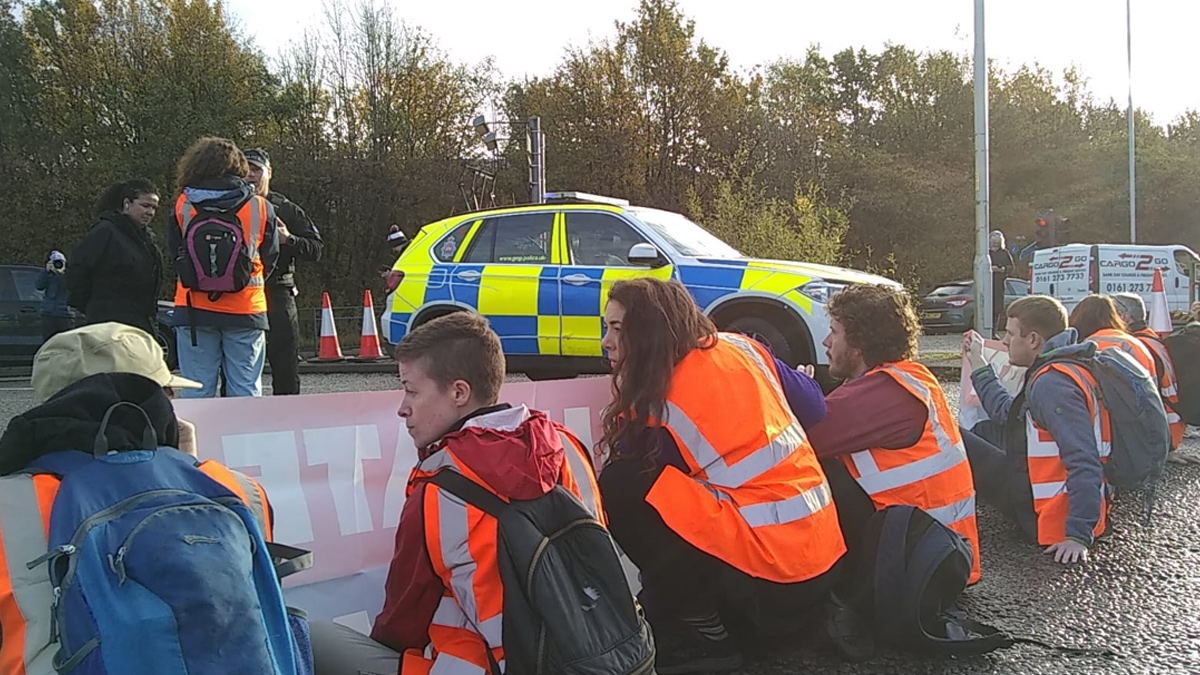
An activist from Luton is among five climate protestors to receive prison sentences for their actions with Insulate Britain. El Litten, a programmer aged 35, was summoned to the High Court along with 19 other Insulate Britain protestors on February 1st. When the court was due to return for the afternoon session, Litten and three others sat down outside the Court of Justice and glued their hands together.

El Litten, 3rd from right, takes part in a protest outside the High Court, February 2022. Photo: Denise Laura Baker

While other protestors received suspended sentences, the act of resistance at the hearing earned Litten a custodial sentence for contempt of court. The four were sentenced to between 24 and 32 days.

Insulate Britain, as the name suggests, demand that the government take the “no-brainer step to tackle rising energy bills and the climate crisis by insulating Britain’s leaky homes.” Their protests throughout 2021 caused controversy by blocking ports and motorways.

Energy bills have risen by record rates in Britain in recent months, with the 54% increase in energy costs pushing millions of households into energy poverty. Government programmes to insulate homes have stalled, with the Green Homes Grant abandoned in 2021 after helping to improve just 47,500 of a planned 600,000 homes. No replacement to the scheme has been announced.

Insulating homes would address the cost of living crisis, improve health outcomes, while also cutting carbon emissions.

In a statement, Litten explained her reasons for taking part in the protest at the High Court:

“It’s frustrating that our society allows politicians and businesses to lie with impunity, to make pretty speeches while the truth is that their actions and decisions are causing harm and death on a massive scale. I’d ask the government to do what is right, to act in order to protect lives, not to protect their own power.”

“I cannot stand by whilst our government causes so much damage and so many deaths, both in the UK and on a much bigger scale around the world. I don’t want to be part of the terrible injustice of the climate crisis, with the worst effects always landing on those who have done least to cause them.”

El Litten has previously taken part in Extinction Rebellion actions in Luton, and was one of three XR Luton protestors arrested at Luton Airport in 2019.


Climate highlights of 2021

2021 proved a strange year, in and out of Covid restrictions and with more than its fair share of challenges. But we continued to work towards a zero carbon Luton. Here are a handful of highlights from last year, and here’s to more like this in 2022.

  • The blocks of flats in Marsh Farm are a prominent landmark in the town, and were visibly transformed as a multi-million pound cladding project was completed. The insulation will improve comfort for residents while cutting heating costs and lowering carbon emissions.
  • Perhaps you’ve seen this on a street near you, but did you know that over 6,000 street lights were switched to LED bulbs? The £2.25 million programme is saving money, energy and carbon across the town every night.
  • Vauxhall announced that their entire range will be electric by 2028, making Luton’s Vauxhall plant part of the transition to clean transport. “The future of the automotive industry is electric” said managing director Paul Wilcox. “We are on a journey to reinvent Vauxhall and heading towards a net zero CO2 future.”
  • Local campaigners and residents, including Extinction Rebellion Luton, worked together to successfully oppose plans for a water bottling plant at Butterfield Green.
  • Bedfordshire University was certified platinum by EcoCampus, and ranked 8th out of 154 in People & Planet’s ranking of sustainable universities.
  • After switching to 100% renewable energy and installing new heating, Luton Airport was awarded level 3 in the global Airport Carbon Accreditation scheme – a step towards the goal of carbon neutral ground operations by 2026.
  • Chapel Farm, just outside Luton, is home to a new energy storage facility from Harmony Energy. 49.5 megawatts of Tesla batteries will help to balance the electricity grid and manage increasing amounts of renewable energy in the area.
  • Also outside Luton, but close enough that we’re going to claim it – Whipsnade Zoo are planning a huge solar array in the shape of a lion.

Luton council votes to divest from fossil fuels

In November 2021 Luton Council passed a motion requesting that the Bedfordshire Pension Fund divest from fossil fuels. It received cross party support, putting pressure on other councils in Bedfordshire to vote likewise and bring pension investments in line with climate action plans.

“The borough council has stepped up and become the first local authority in Bedfordshire to support divestment from fossil fuels” said Luton based divestment campaigner Isaac Beevor. “Now we’re looking for that leadership to be replicated across the county.”

As hoped, Bedford Council followed suit in January. Bedfordshire Pension Fund manages the pension funds for Luton, Bedford and Central Beds. With two of the three councils electing to divest, the fund will now wind down investments in oil, coal and gas by 2023.

Bedfordshire will join a growing number of councils that have chosen to divest, as part of a wider movement to withdraw financial support of the fossil fuel industry that is driving climate change. For more information, see Divest UK.

Divestment is the opposite of investment. In recent years a divestment movement has formed to encourage funds and banks to pull their money out of fossil fuels, and stop profiting from the destruction of the climate. Universities were among the first to move, and in 2015 Bedfordshire University also took this step, the second university in Britain to divest from fossil fuels.

Luton declares a climate emergency

On January 13th Luton council voted to declare a climate emergency and announced a target to reach net zero by 2040 – ten years before the national target.

Where some councils have declared a climate emergency and then gone away to think about it, Luton have chosen to do the strategy first. So yesterday we also saw the publication of a broad timeline for how those carbon cuts will be acheived. It includes more use of public transport, walking and cycling, and encouraging electric vehicles. There’s a cycling audit underway in the town. A council operated bus company has been proposed to serve routes that commercial firms aren’t covering, paid for by a workplace parking scheme.

The council is already working on housing, improving energy efficiency in its own housing stock. There will be new schemes for home insulation, and transitioning away from gas boilers. Climate change will be incorporated into all council operations, and all new schemes will be assessed for their impact on climate change. A new scrutiny group will be formed to keep things on track.

The council’s target also includes the airport. While it doesn’t include the flights themselves, this is still an unusual step. Other cities that control airports have made climate plans and left their airports out. Luton Airport, in conversation with Luton Council, have agreed that they will bring their efforts in line with the town and aim to be carbon neutral by 2040.

LEAF will be working to support Luton’s plans, and find constructive ways to accelerate them where possible.

Luton named worst town for air pollution

A study of 146 towns in Britain has ranked Luton last for air pollution. While other areas create more pollution, Luton’s tight streets make it slower to disperse, increasing risks to health.

At the opposite end of the scale, Milton Keynes’ wide and leafy boulevards presents a low risk of air pollution.

Professor Rob MacKenzie from Birmingham University explains: “What we’re interested in is not just how much pollution is produced, but how much is in the air. Our study shows how effective the particular urban form of a city is in dispersing air pollution.”

This is bad news for Luton, although from a ‘glass half full’ perspective, coming last means that we can only improve from here. LEAF will be looking for projects to address our dirty air, and if you are aware of interesting local initiatives around air pollution, please let us know about them.

Because the problem is to do with Luton’s street layout and buildings, there are no immediate solutions. Tree planting is a real science in urban areas, and badly placed street trees can trap pollution and make dispersal harder, so that’s not a quick fix either. The best solutions will be in encouraging greater use of public transport, and more active forms of transport – especially around schools, where idling diesels are a major source of air pollution.